chat

Share

Section377

Sunday, May 30, 2010

Gays Not Welcome INDIAN Army ???


Gay rights activists might well hail the Delhi High Court”s liberal interpretation of Section 377 of Indian Penal Code as a landmark, but a natural extension of the ruling seems laden with the potential of rupturing the high-discipline fabric of the defence forces, particularly the 11-lakh-strong Indian Army.
Although homosexuality in the troops is a raging topic within the armies of Britain and the US, their Indian counterparts consider “certain forms of disgraceful conduct” a serious offence under Section 46 of the Indian Army Act, 1950.
Under the Indian military law, any person (soldier) found guilty of “any disgraceful conduct of a cruel, indecent or unnatural kind” can be punished with imprisonment extending up to seven years if so convicted by a court martial. The provision relates to homosexuality and its presence in the statutes for six decades, if not more, indicates that such behaviour was not alien to the troops.
While the British Army has openly welcomed the entry of gays into its ranks and upheld gays, bisexuals, transsexuals), the situation in the US is largely guided by a ” compromise formula” proposed by President Bill Clinton in 1993.
The formula ” better known as the ” don”t ask, don”t tell” policy ” prohibits gays and lesbians from speaking about their sexual orientation while serving in the US armed forces. The moment this line is breached, the officer or the soldier is liable to be dismissed from service. The US Congress has passed a law that categorically states that homosexuals are ineligible to be enlisted.
The armed forces” sex-segregated environment, particularly in the Indian social context, has the potential of making some personnel indulge in situational homosexual behaviour although, quite often, these men could be heterosexual otherwise.
Senior army officers, who have served in isolated field formations, admit that such “deviant behaviour” was not “very uncommon” but ” the context has to be understood”. “Izzat (pride) being paramount for a battalion, the offenders are never tried under Section 46. When such instances come to light, the accused is either tried under some other section or simply asked to put in his papers,” an officer explained.
The Indian Army Act (1950), a near- replica of the Indian Army Act (1911) brought in by the British, is a “special” legislation.
It is unaffected by the latest interpretation of Section 377 of IPC by the Delhi High Court and, therefore, “unnatural offences” continue to carry severe punishment for the troops.
“But the larger point is that if the government does not challenge the high court”s interpretation, it would have little authority to let Section 46 continue in the Army statutes,” said a senior Supreme Court lawyer.
Interestingly, while the Indian Army Act, drafted under British influence, considers homosexuality as a serious offence, the situation in the United Kingdom has undergone a radical change.
British Army chief General Richard Dannatt has since proclaimed full support to the enlisting of homosexuals into the force and termed it as a “command responsibility” vital for “operational effectiveness”. On Saturday, uniformed representatives from the army, navy and police attended the Gay Pride March at London”s Trafalgar Square, an event which was marked by the presence of Prime Minister”s wife Sarah Brown.
Another Indian Army officer said that the two contexts ” of Britain and India ” could not be compared.
“Fighting for gay rights is largely a metropolitan phenomenon in India. But the Army recruits its soldiers from the villages, where homosexuality is taboo and deviant behaviour. I dread to imagine the impact that scrapping or diluting of Section 46 would have on the forces. Let us see if the Indian lawmakers have the guts to indulge in any such misadventure,” he said. (End of Article)  
This article led me to think along the following lines -
1. Hindus have traditionally dealt with homosexual behaviors differently than have monotheistic (Abrahamic)societies. 
2. Whilst the US might have (had) its straightforward “Don’t ask Don’t tell” policy, we choose to couch our disapproval in more general tones. 
3. Hindusthan’s Army might have continued with a rule of British pedigree; however it’s not without basis in our own traditions. 
4. The feeling I got was that homosexuality should remain undeclared in the Armed forces, for once declared, the existence of such behavior amongst predominantly heterosexual soldiers, becomes untenable. This is true in most if not all organizations and much more so in the Armed forces where one cannot really maintain high morale without worshipping at the feet of a virile Manhood. 
5. But how is our civil-legal establishment taking in this scenario? Especially in the wake of the US Army repeal – will there be renewed calls and implorings for a copy-cat repeal of Section 46? It is heartening to note that as of now our Army is holding up liberal attempts to gate-crash its party but how much longer can it hold off? 
6. Hindu nationalists have uniformly been unflinching supporters of our Armed forces. I think we should start making our views on the subject clear if only as a mark of continued support for our forces’ traditions. 
From point of view of experience, the Section 377 drama has made certain things clear. 
a. Hindu traditions of co-existence can and will be subverted through legal processes. 
- For instance Section 377 (criminalizing homosexual behavior) would never have been a Hindu law because Hindus have dealt with homosexuality by terribly under-prioratizing it. However, the existence of a criminalizing law in Section 377 (instituted by alien rule) provided a handle to crusading liberals to move to decriminalize it thereby effectively legalizing such behavior. So, logically Section 46 must fall too. 
b. Silence on the part of Hindu nationalists will no longer do. 
- During the debates around Section 377 Hindu organizations did not adopt a combative contrarian stance. Except for individual nationalists, there wasn’t really much official Hindu noise. This unwholesome silence encouraged homosexual activists and their friends to hijack the Hindu platform proclaiming “different sexualities are celebrated within Hindu society”. This claim should have been immediately contested and the record set straight. We should have been telling them that Hindu society whilst recognizing the existence of sexualities, nevertheless does not legitimize them as equally valid. 
If Hindu organizations think that there is no threat to our Forces, they need only look at the US Army today. Nothing is impossible with a Barak Obama in our Law Ministry. 
Hindu organizations should at least articulate a loud and clear stance on the subject. 
In closing, 
I would like to point to a very perceptive comment by 
“Tim W”on Lawrence Auster’s site on the topic of the US Army repeal -   
Homosexuals are by definition individuals who are sexually attracted to persons of the same sex. A male homosexual desires other males. Lesbians desire other females. This is obvious, yet it is ignored in media or political discussions of certain homosexual agenda issues. Homosexuals have been trying for years to force the Boy Scouts of America to accept homosexual scoutmasters. These men would take young boys camping. I’ve heard people defend this by claiming that homosexuals are no more likely than heterosexuals to molest children. I don’t believe that’s true, but even if it is, it’s irrelevant. It would be relevant only if adult straight males were demanding the right to take little girls camping. Can you imagine the outrage if heterosexual men were making such a demand?   
Congress is now moving to admit open homosexuals to the military. We’re told that homosexuals are no more likely to engage in sexual misconduct or harassment than heterosexuals. That’s debatable, but so what? Heterosexual men in the military don’t bunk down and shower with the women. But homosexual men will indeed bunk down and shower with the other males if Obama gets his way. Ditto for lesbians and the other females. There would be universal outrage if heterosexual male soldiers demanded to shower with naked female soldiers, but naked male soldiers are expected to shower with homosexuals who might desire them. Female soldiers are expected to shower with lesbians.  
What we’re being told, indirectly, is that homosexuality is a more enlightened form of sexuality. We can’t allow young men to take girls camping because that would lead to pedophilia, but it’s no problem to let homosexual men take boys camping. We can’t let heterosexual males shower or bed down with females in the military. That would lead to sexual harassment, and the ladies would feel uncomfortable that a bunch of lustful guys are seeing them nude. But no one of either sex should have any problem with being in such a situation with a homosexual. Heterosexuals can be barred from situations where sexually improper behavior might result, but homosexuals cannot. Indeed, they have a right not to be barred.

Saturday, May 15, 2010

Wake-UP Call on section377 Encourages GAYSEX Will Destroy Social Fabric in INDIA ?


Wake-UP Call on section377  Encourages GAYSEX 
Will Destroy Social Fabric in INDIA ?

Editors note: We are outraged by the objectionable advertisement on Midday. Today, Mid day news paper from Mumbai carried an objectionable advertisement- A public notice alleging that a person called Mr. Afsar Shaik is HIV positive and the public should be beware. This advertisement with the photo of Mr. Afar  is a violation of Mr. Afsar's privacy and confidentiality.
The Mid day editor and the person placed this advertisement must be punished to the maximum extent permissible under the relevant laws. 
NACO and Mumbai AIDS Control Society must act immediately. Readers of AIDS INDIA are requested to write to mid day articulating your objection
Dear All,
A highly objectionable public notice about an HIV infected person has appeared in today's MIDDAY on page 5.
http://www.mid-day.com/epaper/index.htm
A 'responsible' newspaper of Mumbai,  Midday has acted in utterly bad taste and has evinced unsound judgement, the moment it was decided by themto print (WITH PHOTOGRAPH !!!) such a public notice .
We all  feel very strongly about the issue and as an enlightened citizen/as an HIV programme implementers struggling to fight the second epidemic of stigma and discrimination, we must voice our concern to the newpaper by sending a feedback at
http://www.mid-day.com//contact.htm
There has to be ZERO TOLERANCE to any such (even if inadvertent) acts.
In camaraderie,
Dr.Rajesh Gopal.
e-mail:
dr_rajeshg@yahoo.com

Wednesday, May 12, 2010

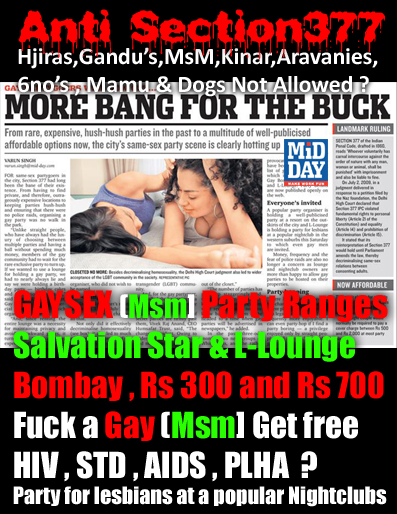
GAYSEX (Msm] Party Ranges Salvation Star & L-Lounge Bombay ??


GAYSEX (Msm] Party Ranges Salvation Star & L-Lounge Bombay , 
Rs 300 and Rs 700 more ?
? Fuck a Gay (Msm] Get freeHIV , STD , AIDS , PLHA  ?  
Party for lesbians at a popular Nightclubs ???
 

Monday, May 10, 2010

Physical assault by gays traumatises young boys


Seventeen-year-old Nagesh (name changed) was on his way home from tuition classes late evening in a crowded public bus when he experienced his first sexual assault - a middle-aged man groped his private parts for more than a few minutes. The shocked teenager, who was coming to terms his homosexual orientation at the time, was repulsed enough to wonder why he was ‘not normal’.
While eve-teasing grabs headlines, the experiences of effeminate and gay men, or youngsters confused about their sexual preferences, being harassed by other men, comes as a surprise to many. “When a homosexual man walks out in public, he is always braced for some form of verbal or sexual assault,” says Mr Sunil Menon, fashion choreographer and founder of Sahodaran, a support group for men who have sex with men (MSMs). From lewd catcalling to groping, and even roughing up, just like in the case of women, the male homosexual victims are disturbed by the incident.
“But these occurrences happen every day, in public transport and even in high-end circles like clubs. Eventually, one gets used to it and begins to treat it as a normal part of their life,” Mr Menon says, pointing out that there is no legal recourse for the victim even if he were to muster enough courage to file a complaint.
However, not all attacks are gender-specific as in the case of those offenders suffering from a psychological condition called frotterism, says sexologist, Dr Narayan Reddy. “Some men need any kind of body contact, either male or female, to get sexual release which they achieve by rubbing themselves against the other person,” he explains. "The impact of such episodes has led to sexual aversion in some patients,” he adde

Friday, April 30, 2010

Patronising Gang of NACO, UN Bodies, Foundations Even GFATM Played a Game ?

Patronising Gang of NACO,
UN Bodies, Foundations
Even GFATM  Played a Game ?
To people silence them ?
Buy Genuine people over ?
kill CSOs and ignore voices ?
which talk of discipline ?
Transparency & Accountability ?
ILOs is no exception. Just Randon
Check Any agency that has
Been "supported" By the Gang ?

Wednesday, April 28, 2010

GAYSEX in Pakistan ??


Most common term in Pakistan is "heera mandi" (sex market). Every Pakistani reading this knows very well about it. This market is flourishing in every town and village of the country. Police and other law enforcement agencies take their "share" in this business.
Last week, all friends of mine were talking about what percentage of people in Pakistan abstain from sex before marriage. We asked this question to 100 boys from different regions of Pakistan in our university. Frank with us, only four students said, they abstained from sexual acts of any type completely. Amongst Muslims in Pakistan, only 7% can fight their lust and don’t commit "zinah". Every honest Pakistani can not but agree with these statistics.
Being a boy, I can not ask girls about this in fear of being honor-killed.
Honor-killing is very common and an act of pride in Pakistan. Every day I read in local newspaper about the honor-killings. But the interesting thing is that those, who honor-kill girls, themselves indulge in premarital sex—a tragic double standard.
It is man's monopoly in Pakistan. Men want to have all kinds of relations with other girls. But when they discover or doubt that a girl from their own family is doing such act of "sin"—then there is only one cure for her, honor-killing.
Despite having such high rate of premarital sex taking place behind the scene—Pakistanis, myself included, used to boast that Western people are shameless and without any moral values for having open premarital relationship. But, now, I think it is everywhere in one way or another. Muslims living in western countries—who think that Islamic lands are pure and such kind of acts, which they perceive as "evils", don’t exist here—should get rid of their vain disillusion. They should never think that Islamic societies are morally good than other societies.
So, if you are looking for a son-in-law or daughter-in-law from Pakistan, there is no guarantee that he/she (particularly he) will be chaste.


KARACHI: Wearing shalwar kameez and a cap on his head, a young man stood at a traffic signal near the Empress Market apparently waiting for a friend.

Humidity had settled in after the sizzling heat of the day as pushcart vendors and gypsy women selling dry-fruit under umbrellas had packed up and left. Suddenly, a car turned around the signal and stopped near the young man. There was only eye contact between them and some indiscernible gestures. The young man sat in the car and they drove away.


One would find it hard to believe that the Empress Market located in the heart of the city is the hub for male prostitution. Everyday in late evenings, dozens of such prostitutes rush to the site to stand there in search for potential customers.

Besides the Empress Market, male prostitutes also seen at the corner near the United Bakery in Saddar town search for potential customers. There are many other such places in the city as well.

To find a group of male prostitutes to speak about their lives, this scribe wandered around the Empress Market and found a teenager ‘A’, who after a lengthy discussion with one of his partners, agreed to take this scribe to his rented home where he lives with two others, also in the same profession. Together with A, this scribe drove to Cantt Station to meet his fellows.

After passing the small lane between the booking office of an air-conditioned coach service and famous fleabag hotel near Cantonment Railway Station, we entered his home.

It was an old-fashioned place with only two rooms and a verandah, a reminder of one of the traditional dairas of a remote tribal village.

In one room, decorated with posters of Indian actors, two young men were sleeping on a straw mat beside which a stereo stood on a wooden bench and some cassettes and CDs were scattered all around.

Both of them greeted us with black kahwah and we started talking about their lives. On the conditions of not disclosing their names, villages and background and also not to take their pictures, they agreed for an interview.

The youngest of them was the first to disclose how he ended up in this business. “I was molested by my schoolteacher when I was only 11 years old... it was very strange and one of the worst experiences of my life. But as time went on, I started enjoying it.”

He further said that after sometime, his elder brother found out about the situation at the school and gave him a severe thrashing. He was then taken out of school to work as a mechanic at a garage. However, he added that the ‘syllabus’ there remained the same.

He then came to Karachi and now works as a male prostitute at the Cantt Station.

None of them had ever brought any customer to their home, they said. “It’s up to the customer where they take us. Sometimes we are taken to the customer’s house, at times to a hotel, or we have to give our services even inside the car,” said one of A’s friends.

There are countless cheap hotels around the railway station offering rooms to any one on hourly basis. They told this scribe that they have many friends who work as male prostitutes in different areas of the city. “However, some do it just for fun and don’t accept money,” said A. The male prostitutes could possibly be between 15 years of age to 25, but some are even as old as 40.

The Empress Market, Saddar, Tariq Road, Bahadurabad, Mazar-e-Quaid, Al-Asif Square, Baldia Colony, Merewether Tower, Cantt Railway Station, Hill Park and the posh areas like Zamzama, Seaview are hot spots for these prostitutes and their customers.

On some occasions, they are forced for their services without any payment. “Sometimes, police or night watchmen catch us and force for sex without payment, but it rarely happens as we avoid going to places where they are present,” he said.

When asked how male prostitutes find their customers on the streets, A said that it’s very simple. “It’s all about eye contact and the rest is understood,” he said.

Tuesday, April 27, 2010

Indian IVF bill Will stop gay couple ???


A growing number of male couples from Australia and other Western countries are hiring surrogates in India to bear children, but that might no longer be possible if a draft bill to regulate IVF in India becomes law.
R.S. Sharma, the secretary of the committee writing a bill to govern assisted reproductive technology (ART), told the Sydney Morning Herald that unless gay and lesbian relationships are legalised in India, gay couples would be excluded from hiring surrogates.
Delhi's High Court recently overturned a 150-year-old section of the country's penal code that outlawed ''carnal intercourse against the order of nature''.
However, gay activists warn this ruling, which in effect decriminalised sodomy, does not legalise gay relationships, leaving the status of such relationships unclear.
"If our government does not permit gay relationships, then it certainly will not be permitted for foreign gay couples to come to this country and have a [surrogacy] agreement," said Dr Sharma, who is the deputy director-general of the reproductive health and nutrition division at the India Council of Medical Research.
The paper quoted Allen-Drury, a resident of Australia's Blue Mountains area, as saying that changes to India's laws would be a great disappointment, if passed.
The draft bill could make it difficult for all Australian couples to use Indian surrogates.
One stumbling block would be a requirement that foreign countries guarantee they will accept the surrogate child as a citizen - before a surrogacy could begin.
Dr Sharma said foreign couples would have to obtain a document from their embassy or foreign ministry pledging the surrogate child citizenship of their country. "Only then will they be entitled to sign an agreement with a surrogate or an ART clinic," he said.
''Under the Australian Citizenship Act, there are no guarantees,'' a spokesman for the Department of Immigration and Citizenship said on Friday. (ANI)